- Networth Farmer
- Posts
- Disrupt, Don't Destroy
Disrupt, Don't Destroy
"That's one small step for a man, a giant leap for mankind." ~ Neil Armstrong

Networth Farmer
April 09, 2026 • Estimated Reading Time: 16 minutes

"That's one small step for a man, a giant leap for mankind." ~ Neil Armstrong
Table of Contents
Fields & Frontiers
New Digital Tool for Wine Grapes: BASF's xarvio FIELD MANAGER For AgBusiness is growing in major markets. Xarvio is giving agronomic advisors and multi-farm operators access to better technologies. It is made for crops like wheat, corn, soybeans, and more, and it gives you real-time information about growth, pests, and field conditions through interactive maps, graphs, and dashboards. Some of the best features are Scouting Trips, which let you prioritise site visits with GPS and offline notes, and customised recommendations to make the process more efficient from planting to harvest. Early users say that the documentation and operations are better. This tool could change the way advisors handle complicated portfolios in other parts of Europe soon. Is digital precision the next stage in your farming plan?
Teagasc Leads Ireland’s Charge in European Innovation: Teagasc has been appointed to spearhead the Irish component of a major new European-funded project aimed at accelerating innovation within organic farming systems. This collaborative initiative focuses on bridging the "yield-gap" by trialling advanced mechanical weeding technologies, bio-fertilisers, and resilient crop varieties specifically adapted for organic production. By integrating cutting-edge AgTech with ecological principles, the project seeks to de-risk the transition for conventional farmers while enhancing the profitability of existing organic enterprises across the continent. This is a pragmatic step towards meeting the EU’s Farm to Fork targets, proving that sustainable soil health and high-tech efficiency can, and must, go hand in hand.
The Italian Precision Seeder: A Friulian startup has discreetly solved one of the main issues with precision farming: getting electric seed distribution to work in the field. Meanwhile, people in Silicon Valley are debating whether or not to electrify farming jobs. The MS 8230 ELEKTRO precision seeder from MaterMacc serves as an example of what happens when modern electricity meets classic agricultural engineering. The machine can work with widths of 2.54 to 6.10 meters and 6 to 12 rows, but the real novelty is how it handles the basics. Find out more on networthfarmer.com.
Sharper Slurry, Less Waste: German maker AgrarPro has launched the ProTube Prime, a new distribution head designed to give European farmers much more precise liquid fertiliser application at low flow rates. Available with 20–48 outlets in 40 or 50 mm diameters, it keeps back‑pressure constant so every outlet gets an even share of slurry or digestate, improving nutrient placement and reducing overlaps and stripes in the field. List prices in AgrarPro’s catalogue start at about €5,000 (excl. VAT) for a 20–30‑outlet unit and rise to around €6,050 for a 48‑outlet version, before dealer discounts. The value add: better use of expensive nutrients, cleaner swards, and easier compliance with tightening EU rules on emissions and leaching.

Brain Teaser
A farmer has 19 sheep on his land. All but seven run away. How many sheep left?
New In Ag-Tech
The Soil Pays Back
Thomas Gent is the third generation to work on his family's farm in the UK. He did not switch to regenerative agriculture because he read a paper. He did it because he saw his soil get harder over the years, his input costs go up, and the difference between cost and return get smaller until it became too much for him. The adjustments were small, including using cover crops, doing less tillage, and rotating crops better. The effects weren't really dramatic right away. But the ground started to heal. Then something surprising happened: someone offered to pay him for it.
When Belief Becomes Bankable
The word most often associated with regenerative agriculture in sceptical circles is greenwashing. It is not an unfair concern. For years, the movement ran on conviction more than evidence, a philosophical commitment to working with natural systems, promoted heavily by brands looking for a sustainability story and adopted unevenly by farms that had little way to measure whether their practices were actually making a difference.
Agreena, a Copenhagen-founded company now operating across 20 countries in Europe, has spent the past several years building the infrastructure to answer that scepticism directly. Their model is simple in concept and technically demanding in practice: enrol farmers, measure what their regenerative practices are actually doing to soil carbon, verify it independently, and connect that verified outcome to a market willing to pay for it.
In September 2025, that model cleared its most significant hurdle. The AgreenaCarbon Project became the first large-scale arable farming initiative to achieve verification under Verra's Verified Carbon Standard — the most rigorous independent standard in the voluntary carbon market. Not validation of the methodology. Verification of the actual outcomes. 2.3 million Verified Carbon Units, each one representing a tonne of CO₂ either reduced or removed, backed by five years of field-level data, satellite imagery, and third-party audit.
"This milestone empowers farmers, the true climate heroes, to adopt new practices through verified credits, while giving corporate buyers the confidence to invest in meaningful climate action." ~Simon Haldrup, CEO, Agreena
How It Actually Works on the Ground
When a farmer decides to join the AgreenaGro platform, it all kicks off with some important data, like their harvest records, field boundaries, and practice history. Agreena's digital MRV system brings together data reported by farmers with remote sensing, soil sampling, and independently validated models to figure out the carbon impact of each field. The farmer can skip installing sensors or bringing in consultants. The platform really takes care of the tough stuff.
What really makes Agreena's approach stand out for sceptics is the story behind the number. The AgreenaCarbon Project has expanded to cover 1.6 million hectares of land that's being farmed regeneratively, and it's happening in ten different countries. They've managed to reduce 1.2 million tonnes of CO₂ and remove 1.1 million tonnes from the atmosphere. Verra's CEO said it's a clear sign that soil carbon projects can really grow and expand. Those aren't projections. These are confirmed historical results from actual farms in the EU, Ukraine, Spain, Denmark, and the UK.
The Revenue Side of the Equation
This is where the talk changes for farmers, investors, and founders. Verified carbon credits are not free money. They are a tool for the market that links a farmer's environmental work with a corporate buyer that needs to show that it is taking action on climate change. Radisson Hotel Group bought a lot of Agreena's first Verra-issued credits before they were even available. Louis Dreyfus Company, one of the biggest traders of agricultural goods in the world, is utilising the platform to help Ukrainian grain producers switch to more sustainable farming methods.

This means that the farmer can make money without having to change what they cultivate, just how they grow it. Less tilling, planting cover crops, and wiser crop rotation. Things that usually lower the cost of inputs anyway. The carbon revenue is on top. You may use AgreenaGro for free, and you don't have to pay a monthly fee or make a commitment to see how much you might make before you sign up.
A ninth-generation Danish farmer named Niels, who works with Agreena, said it simply: healthy soil is the key to a strong future. He is lowering risk, protecting production, and making sure his farm is safe for the future generation. The carbon income shows that the market is starting to realise what farmers have always known: that good soil is valuable.
The Question This Answers
Is regenerative agriculture greenwashing? Honestly, it can be, especially when it’s more about positioning than actual practice, and when there’s no way to check the claim. Agreena's Verra verification is a direct answer to that issue. It doesn't really ask anyone to believe the story. It shares the data, gets it independently audited, and only gives out credits once the results are verified.
When it comes to policy makers working on incentive frameworks, that verification infrastructure is really the key element that allows carbon farming to be implemented on a national scale. Agreena is gathering field-level data from millions of hectares across Europe, which is becoming a valuable resource for agronomists and researchers. This data helps to show what regenerative practices really achieve in temperate arable systems. Hey there! So, for investors, the growing interest from big companies like Radisson and Louis Dreyfus in verified soil carbon really shows that this market is actually maturing rather than shrinking. Pretty interesting, right?
The soil has always given back what you put in. What's new is that we can actually prove it now.
Digital Pasture


Tending Dreams
The Man Who Chose Soil Over Spreadsheets
He spent years in offices and factories. Then the land called him back, and he finally picked up.
Meet Davide. A farmer. Guardian of the soil. Used to work as an IT technician.
Yes, you read that correctly.
Davide Provenzano used to work in factories and stare at screens before he started growing pak choi and pastinaca in the alpine slopes of Piedmont. Draftsman. Person who works with IT. Office worker. The resume of a man who, on paper, had left the nation. Except that the country never really let him go.
It's all the Grandparents' Fault!
Davide spent his childhood in his family's kitchen garden, picking up the natural rhythms of soil and season long before he ever saw a job description. Those childhood hours spent with his grandparents, hands in the dirt, eyes wide open, planted something that no factory shift could ever smother. "You know, that passion for agriculture really came back to me after all those years," he shares, "all because of those childhood memories I had tucked away."
One day, he set aside the keyboard and grabbed a hoe instead. He picked up a few books. He began to teach himself. Starting from the ground up, on a 2,500-square-metre piece of land. Most of us can't commit to a houseplant.
Minor Domains, Major Framework
The once-small plot has grown into Azienda Agricola Humus, a bio-intensive, precision-planned, and profoundly purposeful market gardening operation spread between Rossana and Piasco.
Every bed is standardised. A uniform width for all irrigation tubes. The number of families that Davide will feed determines the precise amount of room that he requires at the beginning of each year. His weekly veggie box, which includes items not found in supermarkets, is being delivered to twenty families. Spare rib. Aquatic greens. Chinese cabbage. Rather than a thousand kilometres, food that travels ten.
So, What Exactly Does a Soil Guardian do?
Davide is involved in a vibrant community in Val Varaita known as the Custodi del Suolo, the Soil Guardians. This group is made up of farmers, dreamers, and quiet revolutionaries who share knowledge and stand up for the land they cherish.
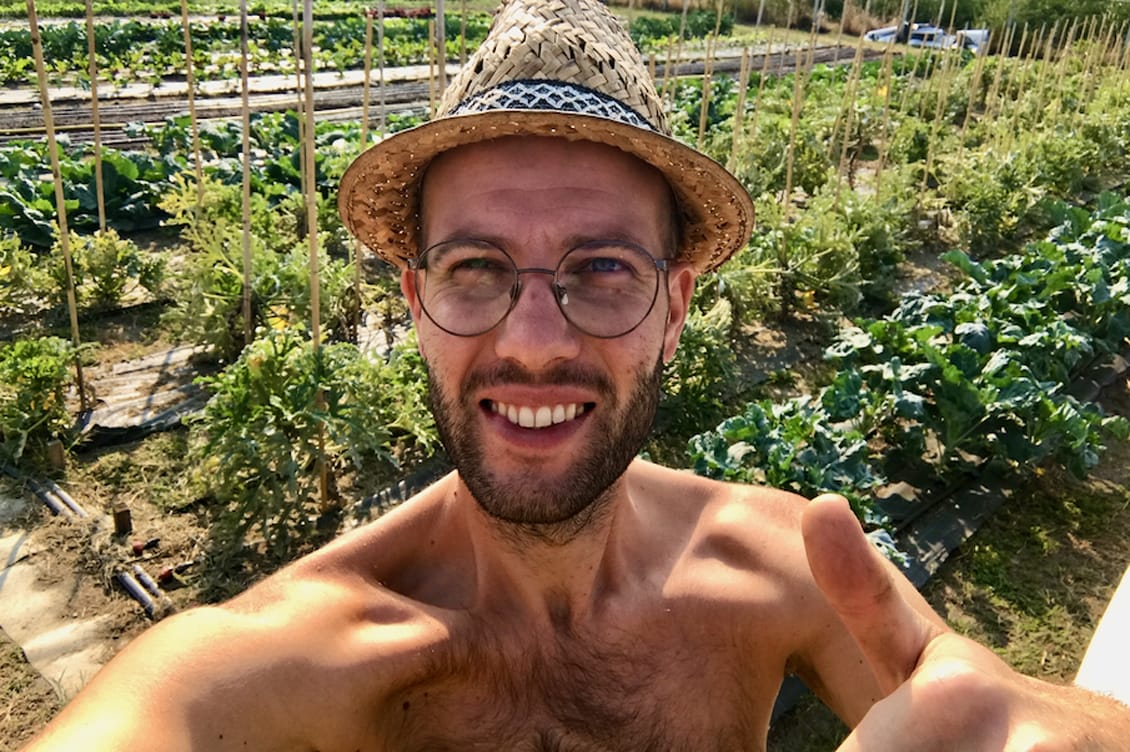
A photo of Davide Provenzano
“Humus,” he says, “is what drives soil fertility.” It all starts from that point. He named his farm after what he looks after. He's dedicated his life to ensuring that the land that nourished him as a kid continues to provide for the next generation. Pretty good for someone who used to work in IT.
More Fields & Frontiers
The Transatlantic Ripple of the Monsanto Ruling: While the Monsanto v. Durnell case is a US legal battle, its verdict will fundamentally reshape the European agricultural landscape. If the Supreme Court shields manufacturers from state-level lawsuits, it preserves the global availability of glyphosate, a cornerstone of "no-till" farming. For European farmers, a US withdrawal of the chemical would trigger a supply-chain collapse and an immediate spike in input costs. Conversely, for consumers, the ruling intensifies the debate over "precautionary" versus "science-based" regulation. A victory for Monsanto ensures lower food prices through industrial efficiency but may fuel public distrust in regulatory bodies like the EFSA. Ultimately, this is a landmark decision on whether national food security outweighs local litigation rights. Find out more on this developing story on Reuters.
Are We Missing a Hidden Chapter in the Big Bang?: What if the universe didn’t just pop into existence with a bang, but instead had a group project that still has us scratching our heads? The latest showdown has traditional Big Bang physics squaring off against the jaw-dropping discoveries from JWST, which are spilling the beans on massive galaxies that decided to throw a party way earlier than expected! Is our timeline doing yoga, or are there some sneaky new physics hiding just out of sight, waiting to be discovered? Some theories suggest we might be in a cosmic trampoline park, bouncing back and forth through time, while others are convinced that tweaking inflation and dark energy could finally settle those pesky arguments that keep popping up. As data comes rushing in like a cosmic flood, the universe keeps spinning its tales instead of wrapping up in a neat little bow! Are we about to have a cosmic epiphany, or is this just the universe's way of saying, "Surprise! We're all in this together!"?
Will Trump Make Regen-Ag Great Again?: Regenerative agriculture finds itself at a critical juncture as Donald Trump begins his second term in office. His government is focused on measures that could accelerate soil health initiatives including cover crops, no-till farming, and rotational grazing. He has promised to reduce red tape and increase farm innovation. With the support of agricultural friends promoting carbon credits and sustainable incentives, federal funds and tax breaks may be freely available to regenerative agriculture. However, deregulation issues, including as diminished environmental protections, are cited by detractors as potentially conflicting with genuine regen ideals. Farmers disagree: will this period greenwash industrial practices or revitalise rural economies? Examine the upcoming policy changes in more detail.
Answer to Brain Teaser
Seven
Till You Laugh


Disclaimer

Follow
  |   |