- Networth Farmer
- Posts
- Guts Over Fear
Guts Over Fear

Networth Farmer
July 03, 2025 • Estimated Reading Time: 14 minutes

“May your choices reflect your hopes, not your fears,” Nelson Mandela.
New In Ag-Tech
Making Wealth From Waste
A quiet change is happening in the beautiful Irish countryside. This revolution could change how Europe thinks about food production, waste, and sustainability. Teagasc, Ireland's agriculture and food regulator, has recently published a study that brings attention to an unexpected resource: potato by-products. Every year, millions of potatoes are thrown away, chopped, or peeled and end up as streams of garbage that are full of nutrients. This includes whole tubers that are thrown away just because they look bad, peelings, pulp, and starchy wastewater. These side streams are not trash; they are full of proteins and starch that can be used again.
Dr. Giulia Romano and her team at the Teagasc Food Research Centre have been testing green extraction technologies, such as grinding, sedimentation, ultrasound-assisted techniques, and enzymatic hydrolysis. From these technologies, they recover up to 60% of the proteins and starch from potato trash. The findings are amazing. Protein isolates lack allergens, making them very soluble and bioactive. This means that they might fight inflammation and maybe even tumors. Such reclaimed starch can be used instead of processed starches.
This innovation is a biorefinery model that doesn't waste anything. By scaling these processes, whole potato-processing factories might be used to turn starch into food or biotech, proteins into food additives, and the rest of the fibers into bio-based packaging or fertilizers. Such an innovation aligns with the European Green Deal and the UN Sustainable Development Goals, which say that food waste must be cut by 2030. The way Teagasc works is exactly the kind of circular innovation that politicians want to see more of.

Why is Teagasc such a big deal for Ireland? Irelanders eat about 300,000 tons of potatoes a year and per capita consumption is among the highest in Europe. It's apparent that there are two benefits: • Economic benefit: Processors get additional streams of income from recovered materials. • Protecting the environment: Starchy wastewater that hasn't been treated puts a strain on water systems since it needs a lot of oxygen. Valorisation avoids this risk.
Teagasc has previously used these technologies in tests on benches (1 liter) and in setups that are close to becoming industrial (300 liters), and they have gotten recovery rates of about 60%. The next step is to run pilot-scale tests in real industries to improve supply chains, energy use, and cost-effectiveness. What starts with potatoes could have a big effect on Europe's food processing industry. There is potential for standardized extraction technology for various starchy crops, such as legumes or root vegetables. We might see the emergence of platforms for innovation that turn trash into markets for bioplastics, nutraceuticals, or fertilizers. I believe that this technology is a proven circular model that gives both small and large food processors frameworks that can be used again and again. Teagasc's findings are very relevant right now. With EU making rules around waste stricter, requiring that food processing waste is cut by 10% by 2030, Teagasc provides a means on how to process responsibly and live sustainably. This innovation is a showcase of how science-based solutions may create economic benefits and address environmental needs.
Brain Teaser
What does the “t” and Island have in common?
De-risking Sustainability; Lessons From The Gulf Region
A growing number of GCC countries are seeing blended financing as a viable option for supporting environmentally friendly initiatives. In 2024, people globally spent $2 trillion on clean energy technologies. This is twice as much as they spent on fossil fuels. That number is still not enough to have the world on track to reach net-zero emissions by 2050. Wood Mackenzie's most recent study reveals that we need to treble our yearly low-carbon investment to almost US$3.5 trillion by 2050 if we want to keep 1.5°C within reach. There is money, but it isn't moving around equitably. In many developing economies, initiatives that could make money have a hard time getting to financial close because the risk is greater than the potential profit.
In as much as the problem of environment affects a public good, governments cannot solve this problem by themselves. The public sector is still the biggest source of climate finance, but the private sector needs to increase the amount of money it gives to net zero. The UAE government promised $125 billion to fulfill this aim. However, experts say that the country will require $680 billion to attain that goal. This creates an opportunity for the private sector to plug in the $555 billion shortfall. The question is, how do they get the private sector money to work.

Commercial banks in emerging nations have to deal with three problems when offering climate finance . First, relatively few projects for renewable energy, climate resilience, or social infrastructure get to the point where they have a strong business case, confirmed purchasers, and the permissions they need to get commercial funding. Second, even when good projects do come up, their electricity rates, concession fees (discounted fees), or other ways of making money are sometimes too low to cover the risks of the country, the currency, and the building. This indicates that the projects don't meet the internal standards that banks need to meet for long-term financing. Lastly, innovative technologies like green hydrogen or regenerative agriculture lack a long track record of utility and profitability. This makes investors charge higher risk premiums. A lot of lenders would rather not take on direct exposure until the technologies are more developed.
For progress to be made, stronger project pipelines and more realistic prices are needed for climate financing to work, not just in the Gulf region but in the world. Perceived risk will keep sustainable finance from moving forward until these issues are sorted. The fundamental problem is how to properly match risk and reward so that more projects get done.
We all agree that Europe’s AgriTech sector stands at a critical crossroads in the face of climate volatility amid a shrinking rural workforce. For every problem, there sure is a viable solution to be discovered. I believe that blended finance acts as the catalytic investment model that’s quietly changing the rules of the game. Through blended finance, sustainable innovations such as regenerative soil technology can be scaled beyond their pilot zones. Strategically mixing public, philanthropic, and private capital is a powerful tool to de-risk investment in sustainable agriculture, especially in underserved or high-risk areas.
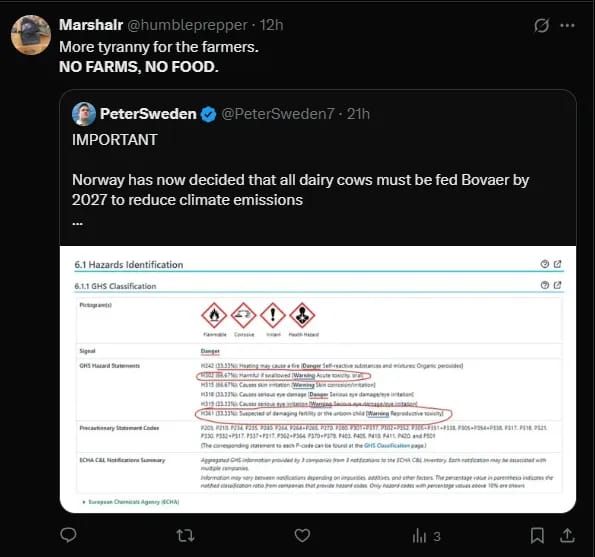
📢 Tweet of The Week



🌎 Out & About
This Weight Loss Hack Works: Cutting on carbs, doing intermittent fasting, reducing on junk food with no results? Understanding the psychology behind why you struggle to loose weight and keep fit is a much more sustainable solution for your weight loss journey. With Noom, the weight loss journey becomes less of a dreadful experience.
Age is not just a number: Aging is complex and linked to most diseases. Increasing health span requires understanding aging molecular changes and developing treatment targets for aging-related disorders. Many research have examined linear changes during aging, however aging-related diseases and mortality risk accelerate at certain time periods, emphasizing the necessity of studying nonlinear molecular changes. Nature.com conducted multi-omics profiling on 108 people aged 25-75 years in their study.
Dogs turn to gold: Doug was a demanding advertising executive for 27 years, and Becca photographed children. The 2020 COVID-19 epidemic made them realize they needed to shift course. With college-aged children, Mr and Mrs Worples sold their Cincinnati home, rented an RV, and went on a six-month road trip. The couple moved to a 270 acre plot in Vermont but soon discovered just how lonely their 4 golden retrievers were. They started hosting events for people to meet and greet their dogs. The Worples' passion for Golden Retrievers became a viral company after Doug and Becca retired. But getting to Golden Dog Farm wasn't easy, and it wasn't in the Worples' retirement plans. Read more on Golden Dog Farm.

A Fully Fledged Summer Festival: Cities across the U.S. are hosting week-long celebrations—with live music, parades, baseball games, fairs, water activities, and fireworks galore. Americans are expected to spend around $130 to feed 10—a mild increase from last year—as beef and egg prices tick up, while fruits and vegetables remain affordable. Good Morning America has tips on how to save during the festivity.
UK Farmers Worried Over Climate Change: In 2024 alone, income from arable crops plunged by over £1 billion, making it one of the weakest years on record. It is not looking good for England as only 2% of its populace are unaffected by natural disasters. From flood-prone Cumbria to drought-stricken Kent, farmers throughout England are getting increasingly frustrated as narrated by The Guardian.
Who Will Be The Next Dalai Lama?: As Nobel peace prize winner, Dalai Lama, turns 90 this Sunday, the selection of his successor is crucial. For strategic considerations, the spiritual leader of Tibetan Buddhism, is of great importance to China, India, and the United States in addition to the millions of devotees of his religion. The Dalai Lama has pledged to share more about the succession around his 90th birthday on July 6, 2025. BBC has more.
💡 A Thought For Friday
Why We Don’t Reach Our GoalsThe year has flown by. We are now on the 2nd half of 2025. A lot has happened and I can’t help but feel a sense of unfulfillment. You see, I am a resolutions kind of person. I like to set goals and achieve them. My vision board is a constant reminder of how far off I fell from the plan. Let’s talk about why we don’t reach our goals. Most pursuits towards accomplishing remarkable goals are not linear. They resemble trading in some ways... It is unusual for large bull markets to rise straight. The most powerful bull markets, usually driven by demand, rise and fall in a stairstep pattern. Although we have evolved into efficiency and higher productivity, we often overestimate how much we can do each time. We are not so great at predicting how long things take and this makes us poor at actualizing our objectives. To succeed, many experts say you need to adopt a "blue-collar" mentality. This entails working hard every day under less |  strict time constraints. Constantly reminding yourself that if you want results that last, you have to put in the time and effort over the long haul. Better outcomes are sometimes the consequence of a more relaxed approach that involves a longer time horizon and more leeway to deal with occasional mistakes or setbacks. Additionally, failure should motivate us to get back up on the horse and give it another go. The place of failure in pursuit of our goals is to make us grow from our errors. Giving up fast on the entire objective is not an option especially in entrepreneurship. Progression over perfection. Now that’s the goal! |
Answer to Brain Teaser
They are both in the middle of water.

Disclaimer

Follow
  |   |