- Networth Farmer
- Posts
- Is Yours the Latest Tech?
Is Yours the Latest Tech?
“Connect to What Matters,” ~Unknown

Networth Farmer
December 05, 2025 • Estimated Reading Time: 8 minutes

“Connect to What Matters,” ~Unknown
Table of Contents
New In Ag-Tech
The Locksmith's Son and the Farmer's Boy Who Turned Dutch Dominance Into Italian Innovation
South Tyrolean chefs had a problem nobody talked about: they were serving Alpine cuisine garnished with watercress flown in from Holland. The absurdity wasn't lost on Ulrich Kager. Growing up on his family's farmhouse and guesthouse in Eppan, he watched as Italian restaurants had to import microgreens from all over Europe, simply because no one was growing them nearby. At 18, right after finishing agricultural school in San Michele all'Adige, he began sketching out plans for what would eventually turn into Profarms—while most teens his age were busy figuring out which university to go to.
His co-founder Patrick Sanin came from a completely different world. As a child, he spent hours in his father's locksmith workshop in South Tyrol, fascinated by mechanical systems and precision engineering. That early obsession led him to study mechanical engineering at the technological high school in Bozen. The pairing seemed unlikely: a farmer's son dreaming of vertical agriculture meeting an engineer's son who understood how to build the machinery to make it happen.
The Technology They Built in a Province Famous for Apples
Three years ago, they worked together to come up with something amazing. It's not new. Vertical farming is already happening all across Europe but it's a methodical way to make it work on a large scale. Their 250m² facility in Appiano has custom-made growing cells with five racks of four shelves each, as well as separate cells for sprouting, cooling, and packing. The system makes 2,000 cartons every month, and each one has nine trays of living microgreens still linked to their substrate.
The substrate choice matters. Profarms grows on hemp or sheep's wool, which keeps microgreens alive for a long time after you buy them. Chefs can pick exactly what they need when they need it, which cuts down on waste and keeps food as fresh as possible. For seven days, seeds grow in the sprouting area. Then, for thirteen days, they go to growing rooms. The whole cycle runs under computer-controlled settings that are optimised by Kager and Sanin's own proprietary software.
Their relationship with C-LED added a lot of important technical know-how. The LED lighting technique gives microgreens thicker cell walls, smaller seedlings, and less water use—90% less than traditional farming. This means stronger tastes and greater texture, which is exactly what Michelin-starred restaurants like South Tyrol, Veneto, Emilia-Romagna, and Naples want.

Image: Profarms
The Twist Nobody Expected
Here's where the narrative deviates from the norm of vertical farming: Profarms cultivates more than simply microgreens. They are currently a technology firm that licenses to other producers their whole system, including seeds, substrate, software, packaging, and know-how. Using Profarms' complete solution, UnoValtellina in Sondrio province currently manufactures 1,000 cartons per month. With the establishment of Profarms Engelberg in Austria in 2024, Hannes and Martina Preitfellner made the switch from traditional herb farming to Profarms' indoor concept.
The enduring issue with vertical farming—profitability—is resolved by this franchise strategy. The majority of vertical farms spend money on single-site expansion in an attempt to reach scale. In addition to sustaining their own certified organic crop, Profarms grows by helping other farmers succeed and generating income via technology licensing. Kager, who is 23 years old, has effectively established a platform company that passes as an agricultural enterprise.
Their strategy is validated by the recognition. The most popular quality label in Italy, Alto Adige/Sõtirol, which has more than 200 producers and 4,600 farmers, recently included microgreens grown vertically inside, quoting Profarms. They have been included into the NOI Techpark system and the start-up incubator at the Free University of Bozen-Bolzano.
What We Can Learn
Right now, Profarms has five people on board, working with three partners. It’s a great example of the kind of youthful agricultural innovation that Europe really needs, especially as its farming population gets older at a rapid pace.
Kager finished high school with microgreens on their mind. Sanin took his mechanical engineering skills from technical school and applied them right into the agricultural field. Neither took the usual route into farming, but both are shaking things up in South Tyrol's agricultural scene, moving beyond the typical reliance on wine and apples.
Their success offers uncomfortable questions for European AgTech investors: why are two twenty-somethings with limited capital outperforming well-funded vertical farming ventures across the continent? Perhaps their success stems from building a business rather than a vision, solving a market problem instead of a planetary crisis, and creating a replicable system instead of a showcase facility.
The locksmith's son and the farmer's boy didn't disrupt vertical farming. They just made it work.
Brain Teaser
Look out at me, vast and wide, I'm where the seeds and dreams collide. What am I?
The Amino Acid Breakthrough Reshaping Crop Nutrition
A new way to feed crops has arrived in Europe for farmers who want to use fewer traditional mineral fertilisers. Arginex, Arevo's advanced technology, fully utilises the amino acid L-arginine.

Photo by Felix Mittermeier
So, what does science say? Arginex is a very advanced foliar treatment that mixes this amino acid with phosphate that plants can use. The idea comes from L-arginine's two functions: it is a powerful biostimulant that boosts a plant's inherent metabolic processes and ability to handle stress, and it also makes phosphate uptake and use more efficient. This synergy lets crops do more with less, which helps everything from root growth to the possibility for higher yields.
The unique thing is that it is now being sold as a strategic instrument for integrated nutrient management in the arable and horticulture sectors of Europe. It's not just additional input; it's a whole new way of thinking. Arginex gives plants the tools they need to better manage their nutrition, which is a real way to cut down on the need for mineral fertilisers. This is important for both farm economics and environmental goals. This is a new way to think about precision nutrition.
Digital Pasture



Fields & Frontiers
Is AgTech's Integration Tipping Point Here?: Despite the buzz, the true measure of agricultural technology isn't in the initial sale, but in its seamless adoption into the daily workflow of the farm. New analysis and a case study from CropX suggest we may be reaching that critical inflection point. Success is no longer defined by a single, standalone sensor or platform. The focus has decisively shifted towards creating integrated ecosystems where data from various systems—from field sensors and farm management software to irrigation controls and even financial tools—flows into a single, actionable interface. This move towards interoperability is dismantling the biggest barrier to adoption: complexity. By stitching together the digital fabric of the farm, companies like CropX are demonstrating that the real value is created not by another isolated gadget, but by a connected, decision-ready environment. For forward-thinking farmers, the era of truly integrated farm intelligence is now within reach.
Epic Says Neigh: Twenty-four hours before launch, Epic Games pulled the rug from under Italian indie studio Santa Ragione, banning Horses (the disturbing horror game about enslaved, nude humans wearing horse masks) from its storefront. Epic had approved the game's release build weeks earlier, reviewed it extensively for two months, and even approved the final achievements-ready build 18 days before launch! Then, after Steam banned the game and media attention exploded, Epic reversed course with a vague automated message citing "inappropriate content" and "hateful or abusive content" violations. Santa Ragione spent two years and $100,000 developing Horses, and now faces likely closure after being locked out of gaming's two largest storefronts. The studio denies all claims, pointing out nudity is pixelated, sexual sequences are brief and censored, and the game critiques abuse rather than promotes it. Meanwhile, Horses became GOG's top-selling new release, proving someone wants to play it—even if Epic won't let them. Read the full controversy here.
AgTech Breakthrough: Agritechnica 2025 in Hanover unveiled a revolutionary leap in agtech, blending precision, autonomy, and sustainability like never before. The standout was Nexat’s 28-metre-wide gantry planter, capable of sowing 72 rows in a single pass, driving efficiency at speeds of up to 16 km/h while reducing soil compaction through controlled-traffic farming. Its modular, electrically-driven design integrates tillage, seeding, spraying, and harvesting in one autonomous system, promising far-reaching impacts on profitability and sustainability. Complementing this was CLAAS’s ‘CultiCam’ equipped with AI-driven weed detection during mowing, creating real-time digital weed maps to optimise herbicide application and future crop management without adding extra field passes. Meanwhile, AllyNav’s agricultural robots—including the Aries300N orchard sprayer and Taurus80E lawn mower—drew attention for their energy-efficient, high-precision automation systems. These innovations showcased Agritechnica’s commitment to smarter, greener, and more efficient farming, setting a bold benchmark for the future of agriculture worldwide.
Switzerland Drops the Hammer: In a surprising turn of events, the Swiss federal administration has announced that Microsoft 365, Google Workspace, and Zoom are not suitable for official use. They pointed out serious concerns about the lack of proper end-to-end encryption and the significant risk of data exposure to U.S. cloud providers due to the CLOUD Act. Starting in 2026, only options that are hosted in Switzerland or fully encrypted will be acceptable. Bern's not the only one speaking up; Germany’s data-protection commissioners and the Dutch government have also raised similar concerns. American tech giants are scooping up sensitive files with hardly any legal hurdles, but now, sovereign nations are starting to push back. If Switzerland, known for its neutrality, is saying “no” to Redmond’s cloud, how long do you think it’ll be before your own government or company does the same?
AI-Powered Pest Traps Meet Carbon-Tracking Platforms: Global pest monitoring leader Trapview has partnered with Netherlands-based Doktar to integrate automated insect forecasting into a holistic digital platform already tracking soil, water, and carbon across farmer networks. Trapview’s AI-powered electronic traps monitor over 60 pest insect species worldwide, providing real-time population dynamics and forecasting development stages with nearly maintenance-free efficiency. Now that technology plugs directly into Doktar's vertically integrated platform combining proprietary IoT hardware, satellite insights, digital twin technology, and boots-on-the-ground agronomic support. CEO Dejan Jančić calls it "the most advanced digital pest monitoring and forecasting technology," whilst Doktar co-founder Selim Ucer emphasises it completes their holistic model: "We already integrate soil, water, and carbon. Adding the strongest pest monitoring solution further strengthens our impact on sustainability and biodiversity". The partnership was announced at Agritechnica 2025, positioning both companies at the forefront of climate-smart food systems with third-party verified MRV for environmental performance.
A Promising New Chapter For Brain Health: Emerging research offers a hopeful perspective for those planning their later years with peace of mind. A significant new study suggests that receiving the shingles vaccine may be linked to a notably lower risk of developing dementia, including Alzheimer's disease. This is a powerful, proactive step within our control. The findings indicate that the vaccine, which protects against a common and painful virus, could also help safeguard long-term cognitive health by reducing hidden inflammation. It reinforces a vital principle: protecting our physical health is intrinsically linked to preserving our mental sharpness. For anyone mapping out a vibrant, independent future, this connection adds a compelling layer to proactive health planning in your 60s and beyond. Open the new chapter on MedicalXpress.
Roots & Records
Agriculture's Oldest Success StoryWhile humans celebrate 10,000 years of agriculture as civilization's greatest achievement, tiny farmers have been perfecting their craft for 66 million years. These master agriculturalists? Ants. And their success story puts every human farming empire to shame. When the asteroid that killed the dinosaurs struck Earth, it inadvertently launched the longest-running agricultural experiment in planetary history. As dust darkened skies and organic matter accumulated, fungi flourished in the apocalyptic landscape. Some ant species seized this opportunity, beginning a partnership with fungi that would outlast every species extinction, climate change, and geological upheaval since. Consider the staggering timeline: ant agriculture predates human farming by a factor of 6,600. While human civilizations rise and fall within mere millennia, ant colonies have maintained continuous agricultural operations through ice ages, volcanic winters, and mass extinctions. 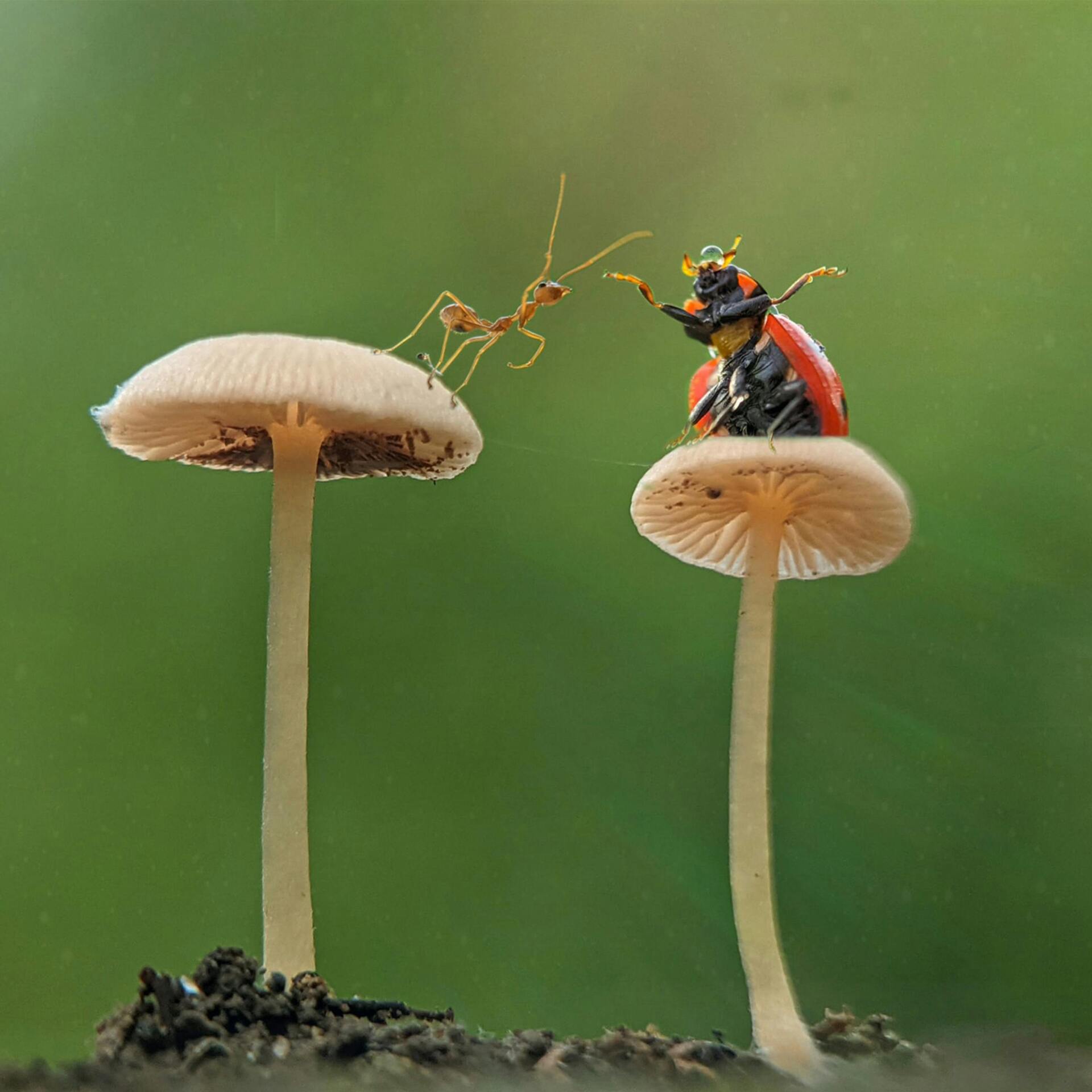 Photo by Macro Photography | Their farming systems have proven more durable than the Roman Empire, more enduring than the pyramids, more resilient than any human institution. Today's leafcutter ants operate agricultural enterprises that would humble modern agribusiness. They maintain sterile growing environments, practice selective breeding, manage complex supply chains, and even maintain backup fungal cultures—a biological seed bank that ensures food security across generations. Their colonies can house millions of individuals, all sustained by sophisticated fungal cultivation techniques refined over geological time. These tiny farmers developed sustainable practices that human agriculture is only beginning to understand. They practice integrated pest management, maintain soil health through organic matter recycling, and operate closed-loop systems with minimal waste. No synthetic fertilizers, no genetic modification, no industrial machinery—just pure agricultural wisdom accumulated over deep time. Perhaps most remarkably, their success hasn't diminished. While human agriculture faces climate change, soil depletion, and sustainability crises, ant farmers continue thriving with techniques proven across eons. The next time we marvel at agricultural innovation, remember: the world's most successful farmers measure their experience not in seasons or lifetimes, but in geological epochs. And they're |
Answer to Brain Teaser
Field
Till You Laugh


Disclaimer

Follow
  |   |