- Networth Farmer
- Posts
- Slow Burn
Slow Burn

Networth Farmer
July 30, 2025 • Estimated Reading Time: 8 minutes

“Nature does not hurry, yet everything is accomplished."
~ Lao Tzu.
New In Ag-Tech
Catalyzing Climate Resilience
Wildfires are no longer rare, isolated events. They have become more frequent, more intense, and more destructive, especially in regions already grappling with hotter, drier conditions. In Europe alone, we’ve seen major fires in Greece, Portugal, Spain, France, and even parts of Scandinavia; burning forests, cropland, and communities that have lived there for generations. In Latin America, fire seasons have extended for months. The fires have also become more intense. According to data from INPE, the Brazilian forest lost more than 25 million hectares to fire in 2022. Globally, it looks like we're going to see more fires in the future, even in areas that haven't experienced them before. Still, the majority of fires are not noticed until after it has spread. Monitoring occurs through the use of human hands. Very sluggish response. The next frontier in fire defense is speed, as the interval between ignition and calamity is getting shorter due to climate change.
Climate tech startup Umgrauemeio is using its AI-powered platform, Pantera, to make significant advancements in forest fire prevention and environmental protection. But before we get into the technical, let’s appreciate the brains behind the Brazilian tech startup Umgrauemeio, which is Portuguese for 1.5 °C. Rogerio Cavalcante, the founder, is a seasoned player in Brazil’s startup world. He kicked off the company in 2016 with an ambitious idea: that tackling climate adaptation would need more than just fresh tools. It would call for entirely new operating systems. Cavalcante gave up his shipping business so he could work full-time on keeping people safe from climate change. He met co-founder Eimi Arikawa at the BNDES Garagem startup. They both had the same goal: to combine precision farming with digital innovation. 1.5 °C focuses on time and terrain to put out the fires before it gets hellish. Pantera's real-time engine is powered by CTO Antonio Leblanc, who has a background in systems design and artificial intelligence. Where there is smoke, there is a fire and Pantera will sniff smoke out in just 3 seconds.
The Pantera platform is built on an AI-powered detection system that sees quicker, farther, and smarter than any human observer. Its 360-degree, high-definition cameras monitor the landscape day and night, detecting fires within three seconds over a 20-kilometer radius, or 125,000 hectares. This is a significant improvement over traditional techniques, which can take up to 48 hours to detect, particularly in distant places. Pantera, however, does more than merely observe; it also knows where to look. Its algorithm finds high-risk areas based on historical burn data, temperature, humidity, wind, and human activity patterns, then prioritises attention where fires are most likely to start.

1.5°C is constructing a system behind the scenes, which makes it more than just a smart tool. One of the biggest wildfire detection networks in Latin America, Pantera is discreetly expanding its footprint with the deployment of over 137 towers and the surveillance of over 17.5 million hectares, 10 million of which are native forests. The system improves in intelligence for every additional hectare. Although Pantera's predictive models are powered by this data density, it also introduces network effects, which are tougher to reproduce. Having more land allows for better views. The results are better when the insights are better. With each new deployment, 1.5°C strengthens its position since better outcomes attract more clients.
Pantera now connects brigades, NGOs, and corporate landowners throughout Brazil's Pantanal, the world's biggest tropical wetland, on a single platform. It has helped find hundreds of fire beginnings, get water and people to the proper place, and stop an estimated 5 million tonnes of CO₂ from being released, all while keeping sensitive areas safe. Pantera has detected approximately 25,000 fires in Amazon, Cerrado, and Pantanal biomes. 1.5 °C says that its deployments have prevented over 18 million tonnes of CO₂ emissions, a significant policy and financial impact. 1.5 °C is currently a SaaS company that licenses its Pantera platform to big sugar mills, pulp and paper firms, and other land-intensive agribusinesses in Brazil. These areas are at some of the highest danger for wildfires, and they generally don't have good insurance, so early detection is both important and useful. Additionally, as businesses start to associate fire visibility with premiums and financing terms, risk and insurance products are on the horizon. Reducing fire hazards not only safeguards business assets, but it could potentially unlock wealth.
Brain Teaser
What can make the octopus laugh?
Climate Crisis Served Hot
Despite the fact that farmers are among those who are most severely affected by extreme weather events, scientists have had a difficult time quantifying the impact that climate change would have on food supply. One of the most significant sources of uncertainty is the degree to which farmers will attempt to adjust to higher temperatures by altering the kind of crops they cultivate, the timing of their planting and harvesting, and the methods by which they cultivate them.
A new study published in Nature says that as the planet warms up by 1C, yields of maize, soy, rice, wheat, cassava, and sorghum could drop by as much as 120 calories per person per day. Think of it as not having breakfast every single day! “In a high-warming future, we’re still seeing caloric productivity losses in the order of 25% at global scale,” said Andrew Hultgren, an environmental economist at the University of Illinois Urbana-Champaign and lead author of the study. According to the report, although climate adaptation in farming wouldn't completely stop productivity losses, increasing wages and modifications to farming methods might reduce them by roughly 25% by 2050 and by 33% by 2100.

A team of researchers from the United States and China evaluated data from 12,658 areas in 54 nations to assess how food producers have adapted to various climate change scenarios. Results showed that by the year 2100, relative yields for crops like soy will have dropped by 26% in a high heating scenario. This was after taking into consideration adaptability, income increases, and the impact of plants growing quicker due to increased atmospheric carbon dioxide. The study discovered that soy would lose 16% of its output, wheat 7.7%, and maize 8.3% under a more realistic heating scenario. Researchers predicted a 4.9% increase in rice yields as a result of climate change, the only increase among the six crops they examined. “In a lot of climate impact studies, the global poor get hurt, and that’s true here too,” said Hultgren. “What is different from a lot of the previous work out there is that relatively rich, well-to-do portions of the world that are bread baskets are actually hit the hardest.” The study, which employs econometric approaches to assess the overall effect of adaptation, differs with prior studies whose model is comprehensively on biophysical interactions.
And with the world's population expected to reach 10 billion by the end of the century, we can't count on flawless adaptation to save us. Cutting food losses and wastage throughout the supply chain reduces the need for additional land and water resources, thereby improving the resilience of the food systems. Perhaps, precision agriculture technologies and new genomic techniques can improve crop tolerance to heat, drought, and pests. Innovations in fertilizer technology can also enhance plant protection, although technology alone is not sufficient. Another aspect of technology would be support services such as early warning systems that prevent any loss to food productivity with the likes of 1.5°C. A holistic approach combining sustainable agricultural techniques, technological innovation, food system changes, supportive policies, ecosystem management, and research collaboration complements climate adaptation to safeguard Europe's food production in a changing climate.
📢 Tweet of The Week
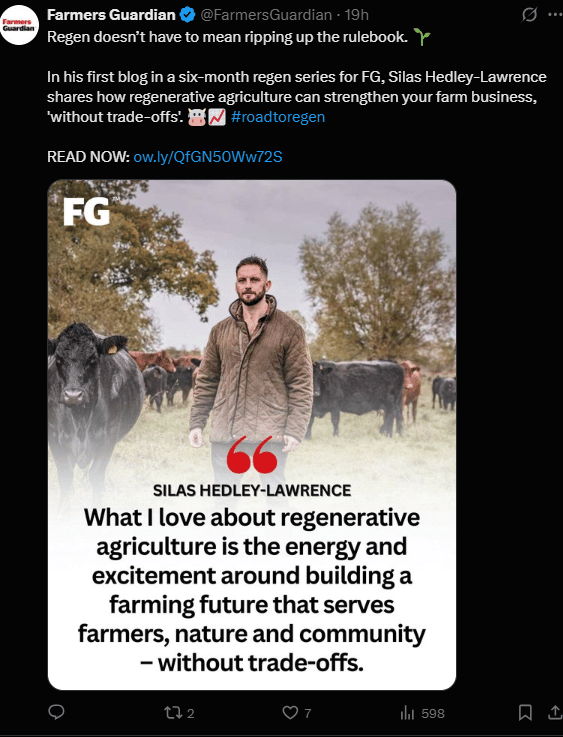


🌎 Out & About
New OMRI-Listed Botanical-Oil-Based Soil Treatment: Kemin Industries introduced RevoCURB™, a FIFRA 25(b)-exempt soil treatment, to offer growers a safer and more sustainable solution for managing pests, diseases, and weeds. The method addresses typical fumigant restrictions in organic and conventional agriculture systems. The emulsifiable concentrate formulation used to make RevoCURB is a Kemin invention. It combines four essential oils—thyme, clove, garlic, and cinnamon—to provide broad-spectrum effectiveness against various pests and soil types. Read more on this New Botanical Soil Treatment.
An Unusual Celestial Visitor: A comet from beyond our Solar System has been confirmed by astronomers. Following the well-known 1I/ʛOumuamua in 2017 and 2I/Borisov in 2019, this newly discovered interstellar object, officially designated 3I/ATLAS, is the third of its type to have ever been detected. Their utterly alien nature is what makes interplanetary objects such as 3I/ATLAS so remarkable. Unlike the other lifeforms in our solar system—planets, moons, asteroid, comet—and all the other celestial bodies—interstellar visitors are completely alien. They have information about the origin of worlds beyond our own and are therefore remains of other planetary systems. Catch the action on Live Science.
More Natural Bread: A new trio of Oklahoma State University wheat types may be the culinary solution for consumers seeking less chemicals — substances added to food products during processing to improve colour, texture, flavour, or, in the case of bread, dough quality. Bread has gluten additions in it to make the dough stronger because the gluten in the bread itself isn't strong enough to make bread products that are sturdy and flexible. The OX kinds of OSU flour—Paradox, Breadbox, and Firebox—seem to give exceptionally high dough strength with variable flexibility. OSU Ag Research explores this organic innovation.
Bitcoin Bitcoin Bitcoin: Bitcoin works best when you understand it before the masses do. But the truth is that most people ignore it until the price rises. Next is the influx of FOMO purchases. When it drops, you'll feel bad. They ultimately decide it's a hoax and depart. When it reaches yet another record high, they will return. We've seen this happen every few years. But people who take the time to learn about Bitcoin during the quiet months, build up their holdings slowly, and focus on long-term conviction usually end up ahead. You don't have to be early to win. You only need to stay longer than other people. Stick around these streets to learn more on this new money that’s here to stay.
Ukraine Export Concerns: Concerns regarding the EU-Ukraine economic ties have been voiced by EU farmer representatives since Russia's invasion of Ukraine in early 2022. A growing number of farmers are worried that the rising cost of imported commodities from Ukraine would further reduce the prices they can sell their goods for. Imports of chicken, eggs, and poultry products are putting pressure on the poultry industry in the European Union. On June 6, 2025, the European Union put taxes and quotas back on Ukrainian agricultural exports. This ended the three-year period during which Ukrainian goods could enter the EU market without paying any duties. This was done in retaliation to Russia's invasion of Ukraine in 2022. Negotiations are currently underway between the EU and Ukraine regarding a new multiannual trade agreement, anticipated to be more advantageous for Ukraine's agricultural sector in contrast to the existing trade restrictions. Is this a win win situation or are European farmers rightfully worried? Find out here.

The Strange Interviewer: A synthetic voice that engages in two-way conversations and provides feedback to recruiting managers is the new reality dawning on job seekers. AI Interviews are becoming more prevalent with proponents emphasizing the technology's ability to boost company efficiency and job seekers' flexibility. The deployment has not been without faults, such as repeated words or misconstrued responses. Startups like Apriora, HeyMilo AI, and Ribbon claim rapid growth and indicate that AI is already being employed beyond the screening step. Read more on this on Bloomberg.
Smoking Kills: Recent wildfires in the west of the US and Canada have resulted in smoke blowing all the way to the Midwest. Pioneer says that the link between wildfire smoke and food growth is complicated, with both good and bad effects on photosynthesis. There are three main ways that smoke affects photosynthesis: it lowers the strength of the light, it spreads the light around more, and it makes more ozone. What does this means to farmers in the Midwest? AgriNews has this covered.
4X Better Than Human Doctors: Costs are increasing at an unsustainable rate, and billions of individuals encounter numerous obstacles to improved health, such as inaccurate and delayed diagnoses, as the demand for healthcare continues to increase. There might be a breakthrough. AI can now do what expert physicians struggle to do. The Microsoft AI Diagnostic Orchestrator (MAI-DxO) detects up to 85% of NEJM cases, four times better than experienced physicians. More and more people are turning to digital tools when seeking medical advice and this invention might be onto something. Find out more on Business Insider.
Allergic to The World: In the midst of a crowd, Countless souls endure, A dance with unseen foes, where scents and chemicals lure. People have long complained that man-made substances in their surroundings cause health problems such as migraines, asthma, tiredness, and mood swings, but the medical community has mostly rejected these claims. The American Medical Association, World Health Organisation, and American Academy of Asthma, Allergy, and Immunology do not recognise chemical sensitivity as a diagnosis. Why, these experts pondered, might people react to minute amounts of a wide range of chemicals? And why didn't they ever seem to improve? WIRED featured a story of one scientist, Claudia Miller, who has been struggling for decades to understand why, motivated by her own allergies.
Answer to Brain Teaser
Ten Tickles (Tentacles)




Disclaimer

Follow
  |   |