- Networth Farmer
- Posts
- Soil Meets Soul
Soil Meets Soul
“The master's eye is the best fertilizer” ~Unknown

Networth Farmer
October 10, 2025 • Estimated Reading Time: 17 minutes

“The master's eye is the best fertilizer”
~Unknown
🚜 New In Ag-Tech
Five Signals That Will Separate AgTech Winners from the Walking Dead
The Reality Check From Wednesday
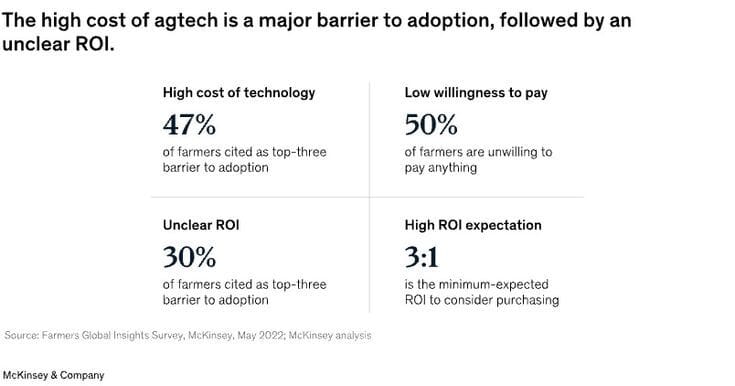
We exposed the unsettling reality: adoption of AgTech is still incredibly slow throughout Europe, even with $18.2 billion in yearly investment. The main obstacles mentioned by European farmers are complexity, unclear ROI, and expenses (48%).Now, McKinsey's study has found five strategic tendencies that set apart organisations that are going to grow from those that are wasting their Series A money on the path to nowhere.
Sign #1: Openness Exists, But Only Under Certain Conditions
This is the chance that is right in front of you: 39% of farmers throughout the world are willing to use at least one AgTech product in the next two years. 67% of them said that rising input costs are their biggest issue about profitability. European farmers say that the cost of inputs has gone up by 80% to 250%, with South Americans being the hardest hit at 247%.
What is the strategic insight? Farmers aren't against technology; they're against solutions that don't directly address their biggest problem: lowering the cost of inputs. Platforms that clearly lower the costs of seeds, fertilisers, and pesticides while providing a measurable return on investment will be the most successful.
Sign#2: Intergration Beats Innovation
Right now, it seems like companies that bring together farm-management software and precision-agriculture hardware are really in a good spot. These all work together to make the most of fertiliser and pesticide use, while also adjusting seeding rates to fit the needs. Farm-management systems that come with precision hardware really empower farmers to take charge of their biggest assets—fertilizers, seeds, and pesticides. Using variable rate applications along with automatic shutoffs helps avoid over-application for specific sites, giving farmers the 3:1 ROI they’re looking for.
Signal #3: Sustainability Needs MRV, Not Just Practices
Europe and North America are at the forefront of adopting sustainability tech, but it's still just at 9%. There's a clear gap here: Brazil has 55% adoption of biologicals and 83% using low-till practices, but only 10% are utilising sustainability tech. Why is that? Participating in sustainability programs means farmers have to gather and check a lot of information—up to 100 different data fields during the growing seasons. Some carbon programs even ask for 3 to 9 years of historical data and have requirements that last for 100 years. Technologies for Measurement, Reporting, and Verification (MRV) that lighten this load will pave the way for wider adoption.
Signal #4: Regulation Is Your Hidden Accelerant
Did you know that government-sponsored programs are behind 40% of the adoption of sustainability initiatives? Pretty interesting, right? Europe's Green Deal and Canada's 2030 Emission Reduction Plan are going to push for the use of farm-management software and precision-agriculture technologies.
Smart AgTech companies are taking the initiative by creating solutions that tackle compliance requirements before regulations even come into play. Using high-resolution fertility mapping along with variable-rate fertiliser application not only boosts productivity but also gives you the documentation that regulators are going to require soon.
Signal #5: Pricing Models Determine Survival
Usage-based models, which range from $1 to $60 per acre, are the most common. However, even the lower-end pricing has a tough time scaling up. What's the issue? Half of the farmers aren't ready to spend anything on solutions since the established players are providing their platforms for free.
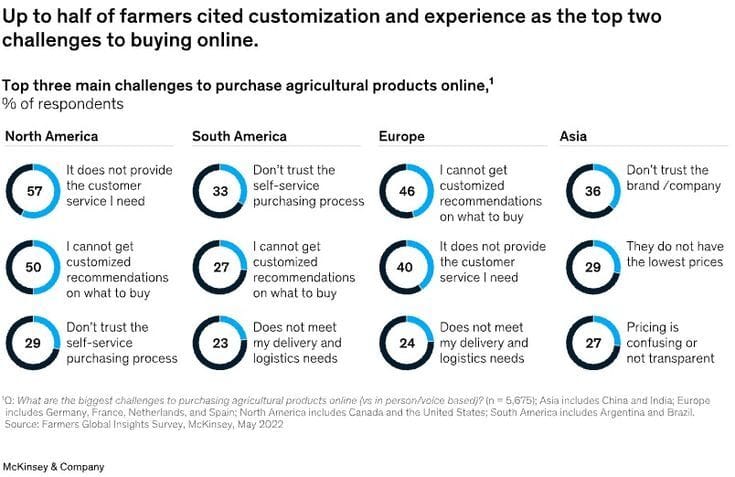
The winning models will feature minimal up-front hardware costs through leasing or renting, combined with scalable pricing structures. With 31% of farmers projecting lower profits, flexibility becomes non-negotiable.
Next week: We'll explore the hidden trust architecture that determines which AgTech companies farmers actually buy from—and why your sales strategy is probably backwards.
Brain Teaser
If two’s company, and three’s a crowd, what are four and five?
EarthDaily's Bet on What Satellite Agriculture Really Needs
Dave Gebhardt, General Manager of EarthDaily Agro, is betting against the odds that agriculture's satellite data problem is frequency rather than resolution. While competitors strive for ever-sharper imagery, his company is developing a ten-satellite constellation aimed to provide something fundamentally different: daily worldwide coverage with scientific precision.
Field Boundary Problem
"When the goal of EO analytics is to provide clear and actionable insights to customers in agriculture and related industries, accurate field boundaries are both an absolute necessity and historically a significant barrier to broad ag tech adoption," Gebhardt told me recently. How did EarthDaily respond? A strategic alliance with DigiFarm's AI-powered field demarcation system, which automates what was previously a resource-intensive manual process. This addresses a dirty truth in satellite agriculture: beautiful picture is meaningless unless you can precisely designate where one field stops and another begins. The collaboration eliminates this barrier while maintaining analytical quality.
The Constellation Advantage
The EarthDaily Constellation is set to launch in 2025, and it’s all about what Gebhardt refers to as "super-spectral" imaging. This means we’ll get analysis-ready data that’s tailored just right for AI and machine learning uses. The newly rebranded Geosys platform lets users pick and choose modular data blocks to help with specific farm decisions, instead of getting lost in a sea of generic imagery.
With thirty years of experience in analysing weather and satellite data from its predecessor Geosys, EarthDaily Agro offers agricultural expertise that pure satellite companies just don't have. “The EarthDaily Agro brand is all about the future of our agriculture and food systems division,” Gebhardt shared. "Now that we're delivering scientific-grade data to more markets faster than ever, users can make informed decisions in no time."
Why Daily is Important
European agriculture is dealing with some pretty unpredictable weather and stricter rules for paperwork. Daily satellite coverage is really changing the game for what's achievable. Right now, systems are only capturing a field every few weeks, which means they’re missing some really important intervention opportunities. Daily coverage is all about spotting crop stress, checking on sustainable practices, or keeping track of extreme weather effects as they happen.
The platform's flexibility really fits well with Europe's diverse agricultural scene, where varying farm sizes and a mix of crops call for tailored solutions instead of a one-size-fits-all approach. Gebhardt's way of handling data management is all about teamwork—partnering with the current agricultural systems instead of clashing with them. This makes EarthDaily more of a supportive infrastructure than a disruptive force.
With satellite technology becoming more common, Gebhardt's emphasis on actionable insights instead of just a lot of raw images might turn out to be really smart. The future of agricultural remote sensing isn’t just about nice images; it’s all about having daily, reliable data that’s ready for AI and fits right into how decisions are made.
📢 Digital Pasture
🌎 Fields & Frontiers
From Broke to Billionaire: At just 27, Shayne Coplan skyrocketed from struggling NYU dropout to the world's youngest self-made billionaire by revolutionizing prediction markets through his groundbreaking platform, Polymarket. Launched amidst the pandemic from a modest apartment, Polymarket's blockchain-powered system now commands billions in bets and major investments, including a $2 billion stake from the owner of the New York Stock Exchange. Coplan’s journey is a compelling testament to innovation, resilience, and reshaping the future of financial betting—making it a must-know story for visionary leaders everywhere. See more on Business Times.
De Heus to Acquire CJ Feed & Care: The Dutch agricultural behemoth Royal De Heus is reportedly closing a deal to buy CJ Feed & Care, the feed and livestock division of South Korea's CJ CheilJedang, in a move that might tip the scales in the global animal nutrition industry. The estimated cost is between USD 800 million and USD 900 million. With the acquisition, De Heus would make a daring move into Asia and a major strategic move outside of its European bases. In Vietnam, Indonesia, South Korea, Cambodia, and other Southeast Asian markets, CJ Feed & Care runs feed, livestock, and fresh meat businesses. Pay attention to De Heus's intentions to integrate activities across continents, regulatory permissions in various jurisdictions, and board approvals. Find out more on Nutrinews.
When Your Only Tools Are Thumb-Sized But Dinner Weighs 29,000 Pounds: Ancient humans in Rome butchered a 13-foot-tall straight-tusked elephant 404,000 years ago using stone tools measuring less than 1.2 inches long – making your farm equipment complaints seem rather trivial. Paleontologists analyzing 300+ skeletal remains found fracture marks matching blunt force impact and evidence that hunters transformed elephant bones into larger tools. The massive Palaeoloxodon antiquus weighed up to 29,000 pounds, yet early human groups recognized an extraordinary resource and exploited every part—not just for food, but by converting bones into implements. This reminds us that human ingenuity thrives under resource constraints. Your ancestors took down megafauna with pocket-sized flint. What's your excuse for not innovating with limited capital? Read more on PopSci.
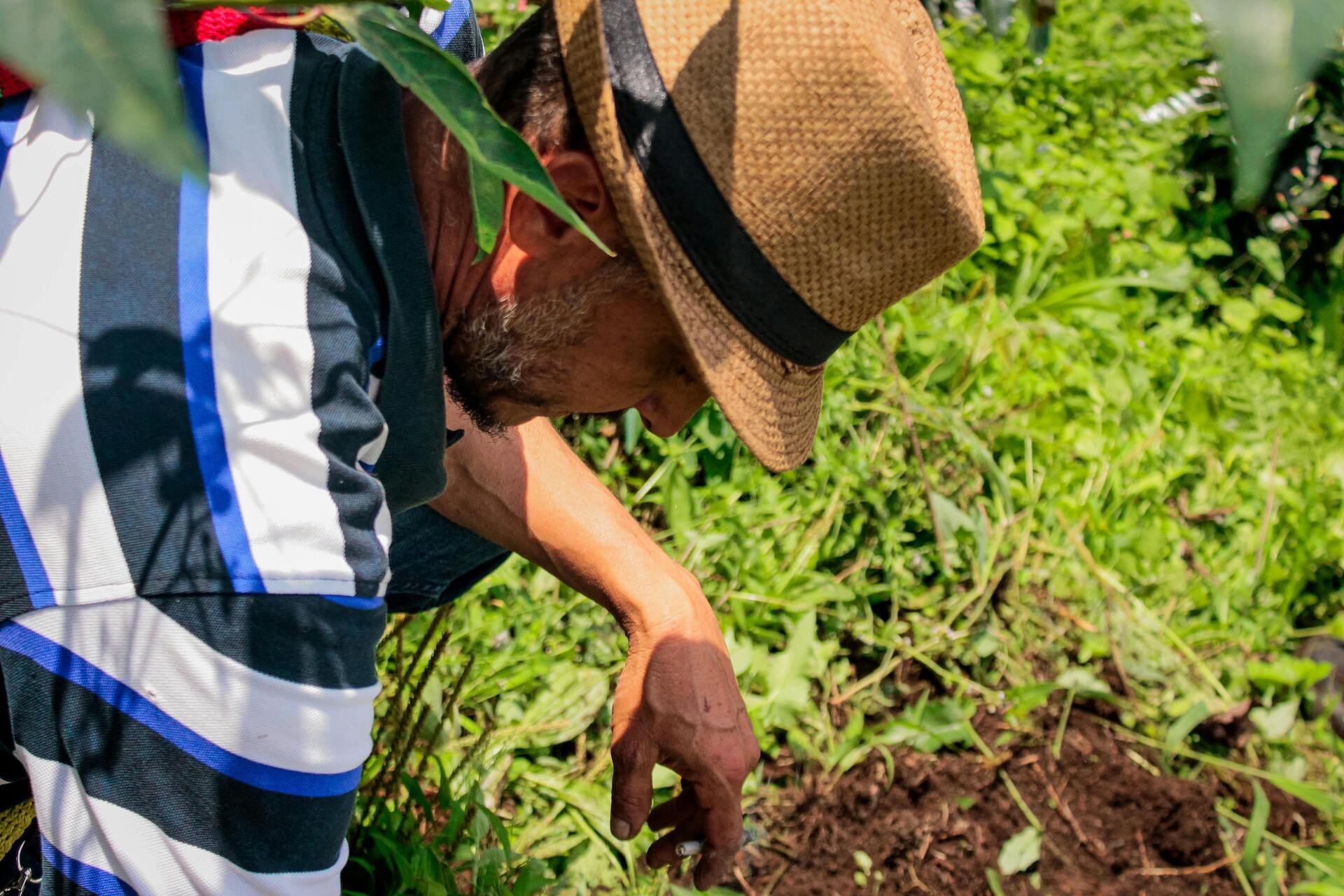
Photo by Juan Diavanera
Caring for the Hands That Feed Us: Farming tests the mind as much as the body. Across Europe, many farmers carry silent burdens—uncertain markets, changing climates, endless hours, and deep responsibility. The EU is responding with compassion, launching new programs to support mental wellbeing in rural communities. From prevention campaigns and 24/7 helplines to peer networks and social initiatives, help is becoming more accessible than ever. This isn’t just policy—it’s people caring for people. If you’re part of Europe’s farming family, take a moment to read, share, and reach out. No one should face the fields—or their fears—alone. This mental health day, please share this with someone you care about.
Miss AI: A lot of people are missing out on the benefits of AI because the data needed to create effective systems just isn't complete, it's all over the place, or it's simply not there. This is a huge setback for agtech: your precision agriculture AI, which was trained on European farms, just doesn't work well in areas with limited data. A 2025 IMF Analysis reveals that economies with well-developed data ecosystems are reaping AI-driven productivity gains three times faster than those that don't have them. So, what's the solution? Generating synthetic data, using adaptive learning, and implementing federated learning all work well even when resources are limited. The question: Are you building AI for the 1% or the 99%?
10 Satellites Finally Bring Precision Ag to Rice Smallholders: EarthDaily has a constellation of 10 satellites that will cover all of Earth's land at a five-meter resolution, featuring 22 spectral bands. They're AI-ready, which is a big step forward in monitoring rice in the cloud-heavy regions of Asia. Rice farming, mostly done by smallholder farmers in places like Bangladesh, Japan, Thailand, and Vietnam, has always been a bit of a challenge for satellite monitoring because of the humid weather and small field sizes. Old-school systems just weren't able to see them clearly enough.
The constellation will take a closer look at water management and scarcity with daily revisits and thermal and shortwave infrared bands—super important for adapting to climate changes. What does General Manager Dave Gebhardt think? "You know, after 35 years in the game, I've realised that when it comes to grain production, water is the real MVP, not just carbon." Next year, the last nine satellites are set to launch, and they could really change the game for precision agriculture, helping out millions of farmers who have been overlooked. Here is more.
💡 A Thought for Friday
Are You Ok?There's this quiet that comes over a farm in October—once the machines have stopped and the long season wraps up. It’s definitely not peace. It’s that kind of silence that feels heavy, like it’s buzzing with tiredness, carrying the burden of another year that’s been gotten through, but not really enjoyed. But here’s the thing: we’re not without power. Every little step counts. Chatting with someone—a neighbour, a counsellor, or a helpful peer—can really lighten a load you didn’t even know you |  had. Rest isn’t about being lazy; it’s more like taking care of yourself. Routine, sunlight, movement, and human connection aren’t just nice to have—they’re essential for getting by. By making it a routine to check our tractors every day, we can also get into the habit of checking in on our minds. |
Answer to Brain Teaser
Nine
😆 Till You Laugh


Disclaimer

Follow
  |   |