- Networth Farmer
- Posts
- Why AgTech Is Reaching a Crossroads
Why AgTech Is Reaching a Crossroads
“Do the best you can until you know better. Then when you know better, do better.” - Maya Angelou

Networth Farmer
December 12, 2025 • Estimated Reading Time: 15 minutes

“Do the best you can until you know better. Then when you know better, do better.” ~ Maya Angelou
Table of Contents
Fields & Frontiers
Payment for Planet Care: A new pilot program in Ireland could soon pay farmers who practice sustainable farming. This idea is gradually gaining popularity in European farming policy. The government and industry partners, including Bord Bia and the Malting Barley Company of Ireland, support the Sustainability Assurance Scheme. It will require farmers to use AgNav to figure out how much carbon their farms emit and show that they are doing things to lower their carbon footprint. They will then get payments from the industry for these actions. If this experiment works out in 2026, it could be a turning point where farmers can make money by taking deliberate climate action instead of just following the rules. Could this be the future of sustainable payments across European agriculture? Find out more on farmers journal.
A Blueprint For Carbon-neutral Farming: 30-year-old Teun van den Borne now harnesses algorithms to outsmart weeds and weather in the flat polders of Harskamp, where windmills once turned grain into flour. As a third-generation potato farmer, Teun inherited 900 hectares of sandy soil from his father, but he's no traditionalist. "We can't keep spraying like it's 1950," he says, his voice cutting through the hum of GPS-guided tractors. There’s more to this young turk we can learn from.
Field-ready Autonomy: Imagine crops being planted with such precision, and the driver keeping an eye on the yields right from a tablet. A contractor just tested out a fully autonomous tractor for bulb planting, and it’s really fascinating to see how it works! They combined semi-autosteering technology with a machine that actually drives itself down the rows, allowing the operator to focus on managing data and making decisions instead of struggling with the wheel. This isn’t just sci-fi anymore — it’s real, field-ready autonomy being tested in bulb crops, where precision is more important than ever. Tune in next week for the full story.
UK Soy Traceability: While Brussels puts off its laws about cutting down trees, UK feed firms are not. This week, the Agricultural Industries Confederation starts its Sustainable Commodities Scheme, which will make it easier for businesses to follow the EUDR. Bunge and ForFarmers, on the other hand, show off low-carbon soy that has been validated by blockchain. This soy has an 80% lower carbon footprint than South American soy since it is sourced without deforestation for 20 years and uses regenerative practices. Almost 100,000 tonnes will come into the Netherlands, which is below ForFarmers' tight limit of 750g CO2e/kg. What does it mean? No matter how uncertain the rules are, businesses are constructing supply chains that can be tracked and verified. But scaling hinges on one thing: if the market will truly pay for sustainability that has been proven, not simply promised.
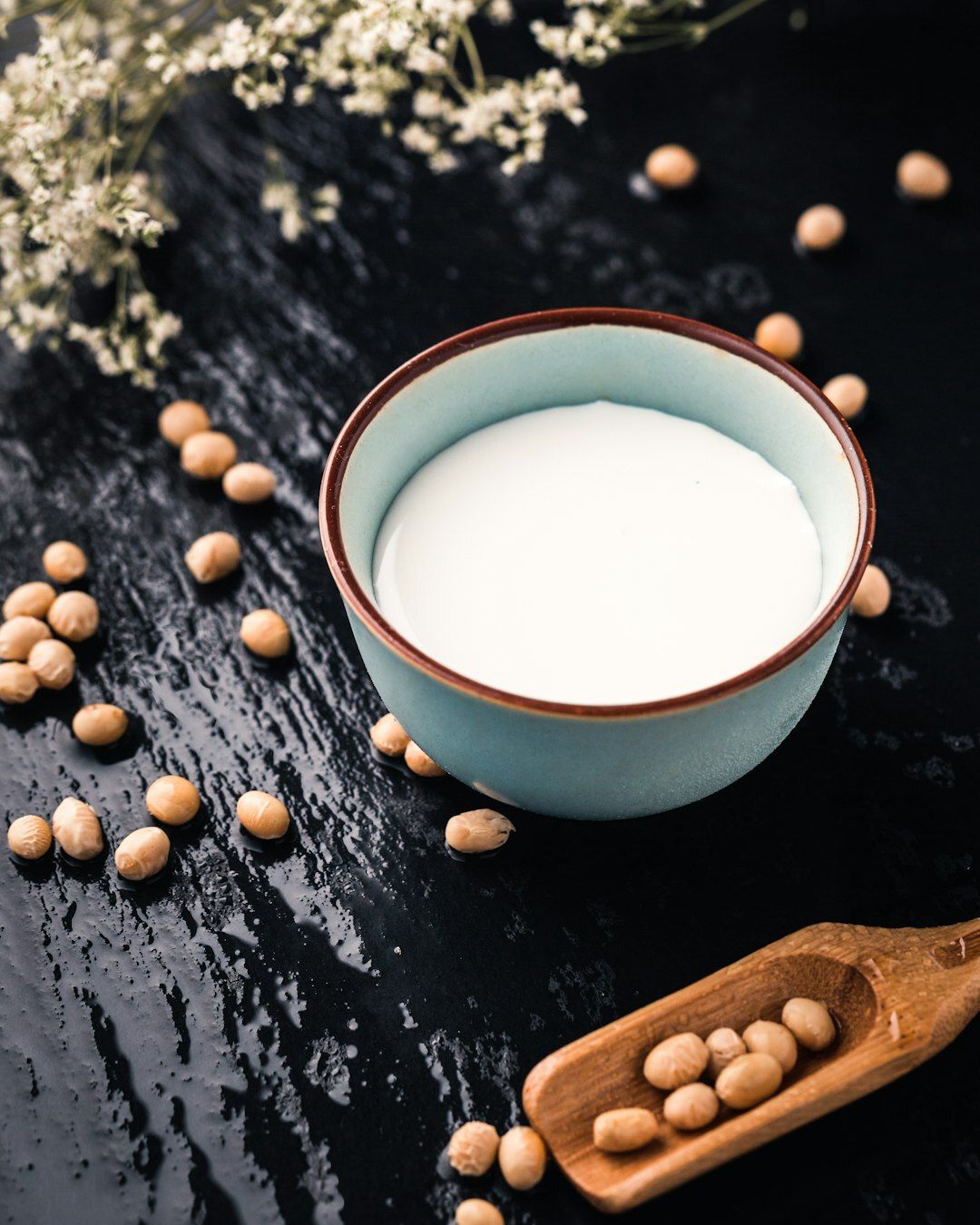
Brain Teaser
What comes next in the sequence?
7, 8, 5, 5, 3, 4, 4, ?
New In Ag-Tech
Why European Farmers Should Care About American Gene Editing
The Stagnation Problem
For three decades, annual yield increases in maize, soya, and wheat averaged just 1%. Inari's CFO Lara Smith Weber states their goal bluntly: "increasing crop yields by 10% to 20% without requiring additional inputs."
Technology That Actually Delivers
Inari's SEEDesign technology blends AI-enabled predictive design with multiplex gene editing, allowing for many simultaneous modifications at multiple sites and with various edit kinds. Unlike standard CRISPR knockouts, which simply turn genes off, Inari's approach allows for "dialling" gene expression up or down—controlling intensity rather than just on/off states.
Practical impact: Inari claims to have increased yields by 10-20%, reduced nitrogen use by 40%, and reduced water consumption by 40%. Their first-generation, high-yielding soybeans are close to commercialisation, with seed business partners already bulking up their offerings. This summer, farmers around the United States can observe altered plants in demo plots. Farmers are currently testing maize and wheat with higher yields in the field.
The European Regulatory Reality
Europe's gene-editing regulations lag dramatically behind scientific advancement. While Inari partners with major seed companies globally (they operate facilities in Cambridge (HQ), West Lafayette, and Ghent (Belgium)), commercialisation in Europe faces significant regulatory hurdles, despite the Ghent R&D facility's pioneering work on epigenome editing.

Photo Credits: AgFunder News
Why Farmers Should Still Pay Attention
Four-time AgTech Breakthrough winner.
Named to THRIVE Top 50 AgTech Companies 2025.
Backed by $771 million in funding including Flagship Pioneering, Hanwha Impact, and CPP Investments.
Chief Scientific Officer Catherine Feuillet named 2025 World Food Prize Top Agri-food Pioneer.
Most critically: Inari is licensing technology to seed companies, not selling direct to farmers. This B2B2C model means European farmers might access Inari genetics through familiar seed brands once regulatory frameworks permit, avoiding the "shiny new toy" adoption risk entirely.
Inari's genetics will work through seeds farmers already trust from established partners. That's enhancement. And it might actually work in muddy fields.
Digital Pasture

More Fields & Frontiers
Pompeii’s Concrete Secret: Why do you think some Roman buildings have managed to stick around even after entire empires have fallen? A recently discovered construction site in Pompeii is providing engineers with just that answer. So, researchers over at MIT took a closer look at some raw materials and tools that were frozen in time by the eruption of Vesuvius back in 79 CE. They found out how the ancient Romans created this amazing concrete that could actually fix its own cracks. Pretty cool, right? It turns out that the Romans had this interesting “hot-mixing” technique. They mixed quicklime, volcanic ash, and water, which not only generated heat but also produced these tiny reactive lime particles. These particles allow the concrete to self-heal over centuries, something that modern mixtures have a hard time replicating. Check out the details.
The Heat Is On: The Copernicus Climate Change Service (C3S) says that 2025 might be the second- or third-hottest year ever recorded, with temperatures around the world rising 1.48 °C over pre-industrial levels. That's a stark signal for farmers and AgTech innovators in Europe. Heat waves, changing rainfall, and bad weather are no longer just occasional problems; they are becoming more and more predictable. Now is the moment to put money into climate-smart technology like crops that can handle heat, precise irrigation, and methods for managing risk based on data. Adaptation isn't optional; it's necessary when the climate changes this quickly. DW has the details.
The Silent Retreat: In the majority of EU Member States, agricultural land is expected to decrease due to urban expansion, afforestation and land abandonment processes. Agricultural land abandonment is driven by socio-economic, political, and environmental factors. Formerly cultivated fields are no longer economically viable under existing land-use and socio-economic conditions. How does this impact agriculture?
EU Initiates Evaluation of Google’s Online Ad Ecosystem: So, the European Union has kicked off a formal antitrust investigation into Google. They're saying that the tech giant might be using its dominant position in search advertising to hold back competition. The probe is going to look into whether Google is giving its own services an unfair advantage and making it harder for competitors to be seen. This is something that regulators and rivals have been worried about for a while now. Wondering how this might change the landscape of digital markets and competition in Europe? Here is the entire story.
Who’s Really Paying the Bill?: Tip jars at the checkout and “suggested tips” on menus; are we genuinely helping service workers, or just shifting the cost from employers to customers? This controversial video dives into how tipping often appears as generosity but may actually mask systemic underpayment. With rising living costs and uncertain wages, should good service still come with a so-called “voluntary” extra charge?
A Thought for Friday
The Quiet Revolution
Ten years ago, we promised farmers the future. They're finally ready to accept delivery but on their terms, not ours. CropX's John Gates describes something remarkable: "A few years ago, a lot of people felt that adoption was stuck. We are not really feeling that from a firsthand perspective." Boston Consulting Group validates this with hard numbers—45% of 1,201 farmers purchased farm management systems in 2024, though only 2% were new buyers. The sector isn't exploding; it's consolidating around what actually works.
Slow Growth, Big Implications
The smart agricultural industry in Europe attained €6.3 billion in 2024, with projections indicating it will reach €19.1 billion by 2033, reflecting a compound annual growth rate of 13.1%. North America dominates with a 35% market share, while the Asia-Pacific region has the most rapid growth. McKinsey's 2024 survey of 4,400 farmers indicates a mere three-percentage-point rise in adoption since 2022; nonetheless, this seemingly insignificant figure conceals significant strategic transformations.
What Farmers Actually Want
Gates explains, "When a tool is really awesome, practical, and valuable, word is going to spread. Conversely, when something doesn't work out, that word is faster." Word of mouth, the oldest way to sell things, currently decides whether AgTech companies will stay in business.
The adoption pattern emerging rewards brutal practicality. Farmers tend to focus on tools that boost their income, are dependable, and help cut down on operating costs, rather than on environmental benefits or tax incentives. CropX's partnership with Reinke really shows how things have changed: the smooth data exchange between the two platforms removes the hurdles that held back earlier AgTech solutions.
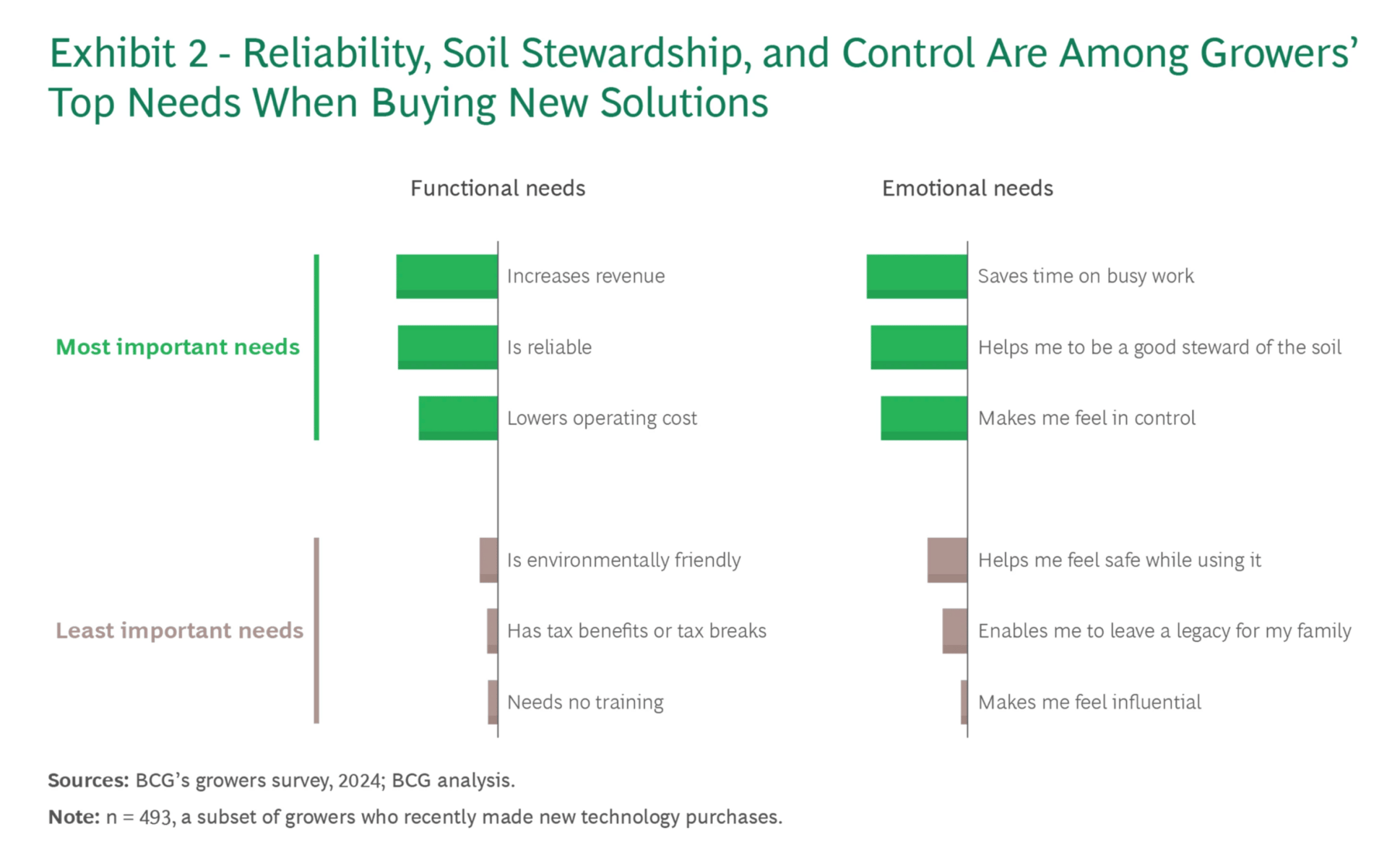
Photo Credits: BCG
Hey there, tech-savvy farmers! You’re not just early adopters anymore, taking risks on untested systems. You're savvy buyers looking for seamless interoperability, clear ROI, and smooth integration without any hassle. Your careful approach kept you from making bad choices.
As for the strategic investors, by 2030, the global AgTech market is expected to reach €48.98 billion, but it won’t just be the companies with the best technology that will succeed. It's for the folks who are tackling real economic issues. CropX is seeing growth because they provide water savings, cut down on electricity use, and help avoid those pesky stuck pivots—not just because they talk about sustainability.
AgTech's second act is really hitting the mark this time around. It’s all about shifting focus from venture capitalists to actually building for farmers, and that’s where the real success lies. As an innovator, you are forced to be more intentional. The tech that comes out on top isn't necessarily the fanciest; it's the one you hardly notice.
Here’s a heads-up for the scientists and agronomists: your validation is way more important than what investors are excited about. It’s interesting to see that 68% of farmers are using crop rotations and 56% are going for reduced tillage. They’re not just jumping on tech trends; they’re actually responding to the agronomic evidence you shared.
This Friday, let's toast to the quiet revolution. AgTech adoption is on the rise, not because we managed to persuade farmers to switch, but because we’ve finally created tools that are truly worth using.
Answer to Brain Teaser
6
The numbers represent number of letters in the months a year and August has 6 letters.
Till You Laugh
Disclaimer

Follow
  |   |